A fundamental tenet of cosmic horror is that the true nature of reality is incomprehensible to the human mind and that being faced with evidence of this reality damages the psyche. What humans perceive as the real world is only a thin veneer over a much darker truth – and that truth is so alien to our understanding that our human minds cannot even contemplate it without serious risk. This dark reality which is so alien to our perception of existence is the Mythos.
Exposure to the Mythos, even briefly, has a deleterious effect on the human mind. Sometimes we are able to delude ourselves into believing there is a rational explanation for what we have seen and heard, thus insulating ourselves from the horrible truth. At other times a person’s mind may twist and fracture to protect them from really perceiving the nature of reality – those are the lucky ones. Others are far less fortunate, as their very being is transformed to integrate the truth of the Mythos into what was once their understanding of the world around them.
One thing is always true, those that catch even the briefest glimpse of the terrible truth are forever changed.
A character that has faced exposure to the Mythos is fundamentally changed by the experience. Their perception of reality is altered – they literally perceive the world around them differently from those that have not seen what they have seen. They see and hear things which other humans do not; their senses of taste, touch, and smell are no longer the same. They may even begin to experience sensations that do not fit our normal human concepts of the senses. This may start small, bordering on imperceptible, but as a character is repeatedly exposed to greater evidence of the awful truth of the Mythos, this change becomes even more profound. (On the GM/Keeper side of the table, this can be used to provide a player with Clues due to their character being able to perceive things other cannot. Of course, Compels based on seeing or hearing things are also fertile grounds for the Keeper to play around in.)
Of course, different characters may respond to exposure to the Mythos in different ways.
Trail of Cthulhu by Pelgrane Press recognized that there are often two different forms of “insanity” in cosmic horror. The first could be thought of as “stark, raving mad” – yelling, crying, screaming, drooling, catatonic, furious scribbling, fits, (presumably) irrational fears – everything that would cause a casual observer to think “he’s nuts.” On the other hand, there are those that appear outwardly normal, even serene, when they are really anything but. Think of a villain that wants to destroy the world to “protect us from ourselves,” a serial killer who selects victims based on whose voice will make the best addition to the “choir” in his mind, or a woman that believes her spirit must be purified by fire before she can attain godhood.
In Our Terrible Fate, each character’s long-term “mental health” is represented by his or her Sanity Aspect and Sanity Stress Track. Before being exposed to the Mythos or suffering other horrific experiences, their Sanity Stress Track is clear, and their Sanity Aspect describes their overall worldview. That worldview could be as benign as If You Dwell in the Past, You’ll Get Left Behind or as extreme as Forgiveness is Between Them and God; It’s My Job to Arrange the Meeting.
As characters encounter the Mythos and evidence of mankind’s true insignificance in the universe – not to mention other more mundane horrors that can nonetheless cause the mind to reel – they will mark off stress on their Sanity Stress Track. Certain points along the track are marked as Warped, Twisted, and Broken. As a character takes sufficient stress to their Sanity to cross these thresholds, their Sanity Aspect changes to reflect how their worldview has changed in response to all they have seen and done. For example, If You Dwell in the Past, You’ll Get Left Behind can be warped into Those that Dwell in the Past Should Be Left Behind. Later, it may become twisted into Only Those that Look to the Future Are Worth Saving.
When changing Sanity Aspects over time, players should consider how they wish to portray their character’s gradual descent into insanity. Are they fortunate enough to be incapable of grasping the truth of the Mythos, as their mind literally fractures itself, slowly cracking in a desperate attempt to shield itself from the horrible nature of reality? These poor souls may eventually be reduced to gibbering lunatics locked away in an asylum, but at least they retain some of what makes them human.
On the other hand, perhaps they are able to come to grips with mankind’s utterly insignificant place in the cosmos. Rather than protecting itself, their mind adapts and remakes itself to accept the terrible truth of reality. These are those that truly become lost to the Mythos. Though they may appear unchanged, their perceptions are so utterly altered that they no longer have the same concerns or cares as the rest of mankind. Though they may be biologically unchanged, their minds have become so utterly alien that they are, for all intents and purposes, no longer human.
In either case, once a character succumbs to insanity – be that raving madman or shell that was once human – they are no longer a playable character.
(Again, on the GM/Keeper side of things, when describing Consequences it is wise to consider how a character is being portrayed as they struggle to retain some semblance of sanity. That’s not to say that an investigator who has been gradually drifting towards megalomania and delusions of grandeur should never be temporarily reduced to a muttering, quivering lump of flesh with an acute fear of open spaces – feel free to mix things up when it makes for a good story – but a player shouldn’t feel forced down a different path into madness simply because the Keeper kept repeatedly throwing out a particular style of Consequence.)
When I played the Peru Prologue with my family, we used some character sheets I had already developed for OTF. They worked great, but I’ve had a few ideas since then – some purely thematic and some more practical.
One idea was to make a fake passport for each PC – themed based on their nationality – and that when unfolded that passport would be the character sheet. That turned out to be fairly easy to accomplish, and I was pleased with the results.
My kids and I recently played Betrayal Legacy, and I noticed a couple of things. We have no problem writing stuff down at the end of scenarios or sessions, but we don’t like to spend time writing stuff down in the middle of a session – preferring to use cards or counters to quickly note changes to characters. In vanilla Fate, the main stuff that gets written on the character sheet during play are Stress and Consequences. In my implementation, other lasting aspects like Drives might also change frequently. That’s not a lot, but since some of those can get added, erased, or changed quite a bit during play, I figure it would be a good idea to at least look at alternatives.
Recently I came across the Kickstarter for Tainted Grail and found their character boards really cool. Then I started thinking about how I might be able to use something similar to reduce the written record keeping on the character sheet. What I’ve come up with is a board that the character sheet gets inserted into (or under).
Mockup of the Investigator Board with the Character Sheet beneath.
The character’s skills, aspects, ties to other characters, sanity, refresh, and stress boxes all show through the board. This allows the player to see everything they need to during play and even make changes to things that might only change once or twice per session, like sanity or ties. The player can place cubes into slots over stress boxes to mark them, and place cards displaying current consequences in different slots based on the value of the consequence. There’s a place for fate points, and the board indicates where to place cards for stunts and drives to the side of the board.
Before I get into what changes I’m making to Fate Core’s rules as written, I think it’s important to look at how I apply those rules to get the style of game I’m going for. The is because I have come to recognize that there are a lot of different styles of gameplay that emerge from Fate’s default rules. I think this is part of the reason that Fate has been so successful – it can accommodate very different game styles without requiring an actual alteration of the rules – you just have to apply the existing rules differently. However, this can also make exposing new players to the game a bit challenging.
There are lot of ways to describe and categorize tabletop roleplaying games, but one key idea that I have found that plays a role in how people approach Fate is the question of authorship. When it comes to authorship, you can think of all games as existing somewhere along a spectrum.
At one end of the spectrum, you have what I think of as the traditional or GM-led style of play, which is characterized by the GM having control over and knowledge of the game world that the players do not. Players only have information which their characters have, and they are only able to influence the game world through the actions of their characters. The GM controls all elements of the game world and possesses knowledge of the game world that is secret until the players uncover it through the actions of their characters. At the most extreme edge of this spectrum you also have GM railroading, where the players only control the moment-to-moment actions of their characters and have little to no say in where the party of PCs goes and what approaches they can take.
At the other end of the spectrum, you have what I tend to describe as a shared authorship style of play. This style is characterized by both the players and the GM being able to control elements of the game world on an equal footing and everyone having access to all information about the game world and the characters that reside within it. There are very few differences between the players and the GM in this style of game, and everyone has to actively distinguish between what they know about the game world and what their characters know.
Default Fate
I’d say that the default rules for Fate fall somewhere in the middle of the spectrum, though exactly where depends on how you interpret and apply some of the rules in Fate Core. This is most evident in how tables utilize the rules for Game Creation. Some groups start from scratch and create a new game world and setting, create characters and game aspects, create issues and some NPCs, and get straight to playing the game – using only the aspects they’ve created to drive play (more shared authorship). Other groups identify key aspects and issues and create characters during session zero, then take a break so the GM can prep everything else before the next session (more GM-led).
Games that make more use of secret or hidden aspects naturally tend more towards the GM-led end of the spectrum. There is also a lot of flexibility built-in to what players can do with the Create an Advantage action. While this action allows characters to change the circumstances around them to provide some sort of benefit, that still leaves some wiggle room. Some groups allow the CA action to alter those circumstances in ways that go beyond what the characters themselves can directly accomplish – for example, introducing a door to exit to a building or declaring that the ground ahead is a marsh in order to slow a fleeing enemy. This application of the CA action enables players to alter the game world beyond their characters – very shared authorship.
Using aspects and fate points to declare a story detail does not have a lot of defined limitations in the default rules, which provides a lot of potential for your players to influence the game world. Compels can be primarily viewed as a tool of the GM, with players occasionally compelling one another’s PCs if there is conflict within the party, but some groups also allow players to make broader use of compels – including compelling NPCs.
Terrible Fate Default
Since my goal is to play scenarios from Call of Cthulhu and other mythos games, my implementation of Fate will be focused on investigative horror gameplay. This means the game will tend more towards the GM-led end of the spectrum. The GM will have a great deal of information not initially available to the players, and the players will primarily interact with the game world through the actions of their characters. Players will be able to exercise limited narrative authority over the game world, but the limits of that authority will be narrowly defined. The GM will have broad authority over the world – and even some authority over the actions of PCs via compels and similar mechanics – while the players will determine where their PCs go and what they do when they get there. In other words, Our Terrible Fate will probably more closely resemble a traditional tabletop RPG than it will a freeform story game.
Chances are that if you’re reading this (and especially if you’ve read any of my previous posts), you are probably asking at least one of three questions:
What’s Fate?
I don’t like Fate, why are you using it for a mythos game?
I like Fate, but why are you using it for a mythos game?
Again, my overall goal is to be able to use scenarios from existing mythos games like Call of Cthulhu and play with my family. Understand that Call of Cthulhu, Trail of Cthulhu, and others are in many ways intended to tell stories like those portrayed in the fiction of H.P. Lovecraft and other mythos authors. Unlike like many other traditional RPGs, Fate is specifically designed to simulate fiction – books, television, movies. So if I focus on trying to tell the kinds of stories you see in that fiction – and the kinds of stories told playing these other games – then using Fate to tell stories in the Lovecraft mythos isn’t really all that strange of an idea.
If you’re familiar with Fate, chances are that you’ve read somewhere that it isn’t all the great a system for horror or investigation – which again raises questions about why I would use this system. While the prevailing attitude towards using Fate for horror has long been that there are better options, there are enough great ideas out there about how to use Fate to run really good horror games that a whole book was released on the subject – The Fate Horror Toolkit.
Update: It’s also worth noting that another relevant development has arrived on the scene since I wrote the initial draft of this post – it’s even a mythos game! Fate of Cthulhu is currently on Kickstarter, and it’s coming from Evil Hat, the creators of Fate. It’s not clear at this point precisely how much investigative horror will play into this game, since it’s billed as “Terminator-style action and adventure” meets the Mythos. I’m fairly confident that this won’t check all the boxes for what I want to play, so I’m continuing with my efforts, but I’m definitely eager to see what they’ve come up with. If nothing else it demonstrates clearly that Fate can handle gaming in the mythos, and I’m proud to be a backer of the Kickstarter.
It’s possible that Fate might not work that well for investigative gameplay, and that this ultimately won’t work. I’m willing to try it any way. At this point, I actually think that has more to do with how some players approach investigative games than any inherent misalignment between the genre and the system. The more I explore some of the great ideas on the net about how to build and play investigative scenarios, the more I think that Fate should work just fine.
Narrative First
One idea that’s important to me playing with my family is that we are able to simply go with what makes sense in the story. I don’t want to have to look up situation-specific rules, and I don’t want players making decisions based solely on stats. I want to be able to ask what they want to do in the given situation, and be able to easily play out their actions. I also want a system that rewards planning ahead and considering the consequences of your action, as that’s going to be an important concept in our games.
The Golden Rule of Fate is this: Decide what you’re trying to accomplish first, then consult the rules to help you do it. This is often paraphrased as “Fiction First” and has a few implications. The first is that you should always start with what a character would do in a particular situation. This should hardly be unusual in a roleplaying game, but in practice with a lot of other games, players get in the habit of taking action based on numbers and what their characters are most likely to succeed at – rather than on how their characters would typically react. Another consequence of this rule (and its corollary – the Silver Rule) is that what makes logical sense take priority over other rules. Needless to say this all lines up very well with my desire to focus on what makes logical sense in the story.
Player Choices
Somewhere along the line in the last few years of reading about designing and gamemastering RPGs, I recall reading that the best games involve challenging and interesting choices. In fact, something I try to consciously assess when I’m considering options for how to apply or tailor a mechanic is to ask if the mechanic forces the player to make an interesting choice.
Fate Core is all about the players making choices. Deciding whether to concede a conflict early and cut your losses or to press on to achieve your goal despite the toll it will take. Deciding whether to take your chances on an even-odds roll or expend precious resources to increase your chances of a successful roll. Spending points to avoid a problematic turn of events or welcoming a new complication in exchange for points you can use later. All of these are common choices Fate players have to make numerous times in the course of play.
It’s often said that players in Fate can accomplish just about anything if they are willing to pay the price. A major Fate player and contributor, Rob Hanz, phrased this as “How much do you want this, and what are you willing to give up to get it?” in his well-known collection of musing on Fate, titled the Book of Hanz. Not only is that very much in line with what I’m going for, it can also make for some excellent stories of dangerous knowledge and tragedy as investigators try to avert disaster in the mythos.
PC Freedom, GM Toolbox
Many games offer a veritable laundry list of options for PCs – how to do X, how to do Y, how to do Z – just about anything a player can think of to try has a rule. There’s just two problems with that: First, that’s a lot of rules to remember or look up, so players rarely remember what they have at their disposal. Second, if there’s not a rule for something, you’re often out of luck. Fate has a small list of basic actions, but when coupled with the rest of the system they can be leveraged effectively to handle anything the players come up with.
On the other side of the table, the same actions give the GM a comparable array of options. By default, Fate Core provides GMs with easy ways to present key issues within the game world, simple methods to both quickly generate simple mob-like NPCs and detail more central characters, and plenty of ways to model just about anything the players can imagine. While Fate Core by default is very setting-agnostic, there are a myriad of mechanics in toolkits available from Evil Hat that provide ways to tailor the system for specific settings and themes. Throw in more ideas shared by a vibrant community, including those in the Fate Codex e-zine, and there is a massive library of ideas and tools for the GM.
Powerful Flexibility
Part of the reason I believe Fate has been so successful is its flexibility. The rules as written (often abbreviated as RAW) are powerful enough to handle whatever you throw at them, without being overly complex. However, a lot of the text can be interpreted in a few different ways, depending on your context and what you’re aiming to get out of the game. In some games, this openness to differences in interpretation and application could hobble use and acceptance of the system, but this has actually worked to Fate’s advantage. New players can face some challenges getting comfortable with the system, but that’s usually due to preconceptions from previous RPG experience or issues of interpretation that can easily be addressed when going for a particular style of gameplay in a specific setting.
The other benefit of this flexibility is that there is almost always more than one way to handle any given narrative situation within the system. This fact enables players and the GM to adopt the approach they find most appealing in light of their preferred play style. It also makes it easier to stay consistent and keep the variety of different mechanics to a minimum.
Scale is also handled extremely well in Fate, so it can handle interactions between two competing galactic empires as easily as it can between two characters. The core techniques and mechanics used to represent a character are the same as those used to represent an organization or a location, so you don’t have to learn a whole new approach to scenario prep or play just because characters are affecting things on a larger scale. The GM can represent a nation-spanning fanatical cult as easily as a single NPC.
Descriptive Aspects
This might seem a bit odd at first, but one element of being a GM that I have long had issues with is describing locations and scenes, especially with investigative games. I’ve never liked reading scene descriptions in published scenarios, partly because such descriptions usually only exist for certain scenes, and I’m not great at improvising detailed descriptions. The biggest issue I’ve seen with this in investigative games is that on more than one occasion, I’ve seen players do one of two things:
Completely miss a big hint that was in the description that should have helped point them in the right direction to move the story forward.
Seize upon a mundane detail that was included only for fluff or color, convinced that it is the key to figuring out the mystery.
This plays a big part in how I’m handling clues in the game, but in a more general way I’ve also seen it impact other styles of games. I don’t like the idea of a GM spending time creating colorful details (which can admittedly aid in immersion), only to have those details ultimately send the players down a rabbit hole and grind the game to a halt. I also don’t like the idea of a game devoid of atmosphere, where the players feel like they can only make use of the specific details the GM spoon feeds them.
If there is one word that best defines how Fate differs from other system, it’s this: aspects. At its simplest, an aspect is a short phrase that describes some element of the game world. Aspects are used to describe important elements of characters, locations, items… everything. They have mechanical effects on the game, and their importance is determined by how much they are used in play – in other words, it’s up to the players and the GM how much of an impact any particular aspect has on the story.
Aspects provide an advantage when it comes to describing scenes because the system explicitly allows you to make assumptions about a location because of its aspects. So if a location has an aspect Archaeology Professor’s Artifact-Laden and Disheveled Office, everyone can assume that a lot of things are naturally present in the office – a desk, shelves, lots of books, maps, papers everywhere, journals and notebooks, and plenty of artifacts – and everyone has enough information to have a shared mental image of the scene. It’s not necessary to detail everything in the office up front. If it’s logical that something would be present, it is. And the GM can still provide more detail in response to the PC’s actions.
Hackable
As a final point on why I’m going with Fate as a starting point, as a system it is eminently hackable. By default, it’s flexibility naturally lends the game to be tailored to your table. Leveraging the many options and ideas available only expands the ways you can customize the system. Even more than that, the system has a lot of give to it. While it is obviously important to understand how changes to one mechanic can affect other parts of the system, Fate is very forgiving. You can make quite a few changes – even to the point of significantly altering how the game plays from one scene to another – without the system falling apart.
Wrapping Up
This has already taken far longer to finish and post than it should have, but I should mention that there is already a mythos Fate game on the market. Modiphius released a Fate Core version of Achthung! Cthulhu, which is essentially a pulpy mashup of WWII and the mythos. Rather than an investigative game involving ordinary people, as is common in mythos games, stories in Acthung! Cthulhu revolve around soldiers and spies in military operations during the war. It is hyper-focused on that setting, so using it for other types of mythos games would require some adaptation. It also does not include much in the way of rules – it is meant to be used in conjunction with the Fate Core rulebook. There are a few rules provided to incorporate horror and mythos elements into the system – and I’m certainly going to look at using them where I can – but it doesn’t offer much in the way of using Fate for investigative gameplay or provide guidance for how to really play Fate in a way that aligns with a mythos theme and setting.
As I’ve mentioned elsewhere, in the past couple of years I have played two Call of Cthulhu scenarios with my family. The first game, The Haunting, did not go as well as I wanted. The second game, the Peru Prologue to Masks of Nyarlathotep, went far better. I learned a lot from both sessions, and studying those experiences can point to what worked well and what didn’t – pointing to a preliminary list of features for my game.
I’ve also played a fair bit of both Mansions of Madness and Arkham Horror: The Card Game, not to mention numerous other board games. Again, examining what I liked and what I didn’t should help define some more features I may wish to incorporate.
Differences Between The Haunting and Peru
There are a few things I did differently when playing these two scenarios. While The Haunting didn’t go badly, my kids had a difficult time with it. We also didn’t really engage the system that much, and wading through the content of the prop handouts I used consumed a lot of time without a lot of benefit in terms of driving the investigation forward (great for immersion though).
System
When we played The Haunting, we used the Trail of Cthulhu conversion. There were very few dice rolls, and in general we didn’t engage the system except for during character creation. We didn’t quite reach Corbitt before we had to stop, which assuredly would have used the system due to combat. Not sure that would have gone well anyway, since we didn’t use the system much leading up to it.
For Peru, I used a work-in-progress version of the system I’m working now, which is a custom adaptation of Fate Core. There were a few parts of the system we didn’t engage with as much as we probably should have, but that was due more to some mistakes on my part as GM. I should have made the difficulty of rolls known to everyone, which I think would have helped drive the Fate Point economy. (I was leaning on my past experience of using unknown difficulties to help build suspense, but that wasn’t necessary.) I probably called for a couple of rolls I shouldn’t have, since I didn’t have any good ideas for complications from failure. And I should have called for a few more defense from horror rolls when the investigators encountered something strange or horrific.
Overall though, we definitely used the system a lot more in Peru, and it never felt like we had an excessive number of rolls. I had already put together a conversion doc that helped me quickly identify what skills would typically apply. However, even when the players wanted to take some action that wasn’t explicitly covered in the scenario, the Fate system made it easy to quickly identify a skill and mechanic to handle what they wanted to accomplish.
Character Creation
I think one of the differences that had the biggest impact for my group was how we got started with everyone’s characters. Our first time around we created characters from scratch using the ToC rules. This got the adults interested in their characters, but we spent a lot of time on this – and since we didn’t engage the system much, it was largely pointless. The choices of professions and such was interesting, but no one had a clue how the numbers for the skills would be relevant. We ended up spending around two hours on creating characters, whereas if we had spent less time on this we probably could have finished the scenario. More importantly, the kids were completely lost during this part. There were way too many choices for them to pick from, which turned them off from the beginning.
When we played Peru, I converted the pre-generated characters over to my Fate Core implementation and presented them to the players. So three people were choosing between about 8 characters. Since I was using a version of Fate, each investigator had a handful of aspects that provided a quick summary of the character, which made it easy for everyone to see how the investigators were different from one another and make a choice. After the investigation got started, I also had each player come up with a Drive for their investigator – basically a goal or concern they had related to the scenario or the other investigators. We didn’t have much opportunity to actually use those Drives in the scenario, but it allowed a bit of customization without requiring a lot of time.
I’ve though quite a bit about how best to handle creating characters in my game. I like the idea of starting with pre-generated characters for the first scenario or two and then allowing custom characters to be created. I also think providing the option to use pre-generated characters in later scenarios could useful – especially if you have additional players join the group. The option to customize pre-generated characters could also be useful. I want character creation to be quick and simple, but still allow for player choice and customization. When it comes to creating investigators from scratch, I’m also thinking of starting with a limited number of choices and then expanding them over time. This makes it easier to get familiar with the process without being overwhelmed and helps support character creation being quick.
I’ll probably deviate a fair bit from typical Fate Core character creation. The focus on the player characters in cosmic horror is very different from that of vanilla Fate Core, and the likelihood that investigators will die or go insane is usually fairly high in these types of games. I want the players to be invested in their characters, but not feel so attached to them that they are put off when they have to be replaced.
Character Creation Design Goals
Incorporate pre-generated characters
Allow pre-generated characters to be customized (Drives, Stunts, Ties)
Allow creation of new characters
Quick and simple character creation combined with player choice and customization
Limited initial character creation options that increase over time
Character creation is one of the areas where I have some developed, but a lot planned conceptually. I’ll create a separate post delving into this in more detail.
Clues
A central element to investigation-based gameplay is the discovery and interpretation of clues. One mythos game that really embraces this idea is Trail of Cthulhu, and it also touches on there being different types of clues. Building on this idea and adding a Fate twist, I handled clues a little differently with Peru than I did in The Haunting. This ended up working to great effect.
When we played The Haunting, I used lots of props, so there were plenty of documents that provided clues to the investigators. While these were great for immersion, they did little to overcome some of the common challenges with investigation games. Without going too much into it here, the players had difficulty parsing through the documents to separate the clues from the fluff, keeping track of the clues they had uncovered, and piecing together clues any sort of helpful way. When we ran Peru, which has far fewer physical documents, the players nevertheless had a far easier time keeping track of clues and figuring things out. They still had to find the clues and interpret them, so the core of this kind of gameplay remained intact without many of the usual challenges. (They even interpreted the clues incorrectly, but were still able to bring about a generally successful conclusion to the scenario.)
The first thing I did was to give clues a little more of a defined structure. Rather than a document or “the information Mr. Knott told you” being treated as a clue, each piece of relevant information obtained from those sources is a separate, discrete clue. So a document may contain several clues, each of which is written as a short, bite-sized, phrase or sentence. (Each Clue is also an Aspect, which has some other interesting advantages, but more on that elsewhere.)
I then created cards for each Clue, which were given to the players as the investigators uncovered them. I still gave the players documents and other props, which continued to provide immersion, and the players only received the Clue cards once they had read the documents. The Clue cards proved extremely helpful. The players could use them to keep track of and review what they learned and easily differentiate between actual clues and information that was just fluff/detail. I also categorized Clues as either Core (vital to the successful completion of the scenario) or Supporting (helpful or background info, but not indispensable), which is useful when determining how to handle investigator efforts to find those Clues.
Clue Features & Design Goals
Clues written as Aspects on Cards
Clue types – Core, Supporting, Floating
Use props whenever possible for documents, etc.
Clue and Encounter maps for the Keeper/GM
Some Clues lead to other scenarios (Fragments, Seeds, Hooks)
Locations
Mock up of Boston board used in The Haunting
One thing I had a lot of fun with when we ran The Haunting was a map of the locations in the scenario. I printed a large 20s-era map of Boston and put it on a bulletin board. I then printed out small collages of images for each place and pinned them to the board, with thin yard tacked between the place and its location on the map. As new locations cam up in play, I added them to the board. Gave everything a nice investigation/conspiracy feel and provided the players with some images to help visualize each location.
However, using this board did have a couple of issues. First, it was rather large. We had to either let it take up one whole side of the table or put it off to the side, which meant the players had to get it and walk to it if they wanted to look at the images or reference the map for any reason. It also meant that any time a new location was added, it took a minute to post it to the board and tie it to its location. Most importantly, using the board meant that putting everything away between sessions either took up a lot more space or a lot more time.
When we played Peru, I took a page from Arkham Horror: TCG and decided to use cards. In that game, each location is represented by a single card. Obviously, this doesn’t take much space, and it has the added benefit of allowing for any size location to be represented in the same way. I made a card for each location that contained its name, an image, and an aspect or two describing the location. I started out with only the starting location in play. As places came to the attention of the investigators during the scenario, I put the cards for those locations into play (assuming they knew enough of the location to actually get there).
In practice, this worked extremely well. The players were provided with an array of options of where to go, and as they gathered Clues and learned more they revealed new locations. Essentially, it provided a visual path to follow. They still had to decide where to go and what to do when they got there, but they always had some idea of where to go to look for more Clues.
I also created a sort of “board” for the Ruins in Peru. The idea was to echo the process of exploring a location in Mansions of Madness. I showed the players the map of the Ruins and they described what they were doing as they checked them out, but once they went underground, I laid out tiles representing the tunnels under the ruins. They started out with only a couple of tiles branching in two or three directions. As they explored I added more tiles (and also a few Aspects that described the environment). Combined with the creepy sound effects of the Peru module for Syrinscape that I was using, the players were definitely spooked and cautious. It worked fairly well, even with just basic white tiles with no art. The descriptions provided by the Aspects and the process of revealing the map only as they explored it, plus the atmospheric sound effect, was more than sufficient to set the mood and keep them on edge.
There were a few things that need to be refined too. I think providing the players with the map of the ruins worked okay, but I think using cards to represent each area of the ruins could have some benefits. The ruins on the surface were kind of an odd middle ground between the “Encounter” and “Investigation” levels of the game, so I need to look at that some more. When there wasn’t anything of consequence for a couple of tiles in the tunnels, the process of “Which way do you go? That way. Here are more tiles. Now where?” got a little tedious and pointless. Obviously, Mansions of Madness has a lot more structure defined with turns, actions, and such, so I’ll have to work on how to structure this Investigation level of play better. I hadn’t really delved into that yet for this first play through, so all in all it went well. And of course having art for the tiles would be a big improvement. I’m a little concerned that while converting scenarios to this system should be fairly simple for the most part, creating tiles for the Investigation of specific locations could be a challenge and big time sink.
Location Features & Design Goals
Support quick set up and tear down
Include image and descriptions/Aspects for each location
Use cards for locations at most levels of gameplay
Put location cards into play as players learn of them
Player pieces can be placed on cards to indication their location during Encounters
Investigation of locations transitions to tile-based board/map with player pieces
Additional tiles are added as players explore
Support additional locations not specified by the scenario, as players desire to visit other places
Non-Player Characters
In games like Call of Cthulhu, keeping track of all the non-player characters the investigators come across can sometimes be a bit of a challenge. This can be such a big issue in larger campaigns that Chaosium’s most recent edition of the epic Masks of Nyarlathotep includes 12 pages of NPC portraits that Keepers can present to players just to help them keep things straight. It’s always a good idea to provide information in more than one form (spoken, text, images, etc.) whenever practical, since different people have an easier time processing and recalling information in different ways.
There aren’t that many NPCs in The Haunting, and only one of them is all that memorable. Since we didn’t reach him during our play through, NPCs weren’t that big of a deal during that game. On the other hand, investigators in Peru will actually get most of their clues from NPCs. There is a lot of repeated interaction with different NPCs, and even one that uses an alias. Again, I used cards for each NPC, including the image from the scenario guide and a couple of descriptive Aspects. Worked really well for helping the players get a quick impression and keep track of everyone.
One thing I need to do differently is with the Aspects for each NPC. I included some information on the cards that the PCs wouldn’t reasonably be aware of at first. I need to focus on basic first impressions and allow for additional details to be added as they are uncovered. Additional details/Aspects could be physically written on the cards, put into play as separate cards, or an alternate version of the card could replace the original. I actually used the last approach for one of the named NPCs in Peru whose “true physical nature” is revealed partway through the scenario.
Character Features & Design Goals
Use cards for each named NPC or mob
Include name, image, and descriptions/Aspects for each character
Allow for additional details of NPCs to be revealed and put into play, beyond what’s on their card initially
Wrap Up
Obviously, there are plenty of other elements to the game – details on the investigators, character advancement, tying scenarios together, etc. – but these are the big ones that made a clear difference in our two games, so they are taking center stage to start out. As I mentioned, I already have more developed or planned for character creation and clues as well, which I’ll hopefully get around to posting in the near future.
In Part 2 I looked at some of the big name mythos roleplaying games out there and briefly discussed a few reasons I’m not just playing them. Of course, those are not the only mythos RPGs available – it’s actually a very good time to be alive if you’re into mythos gaming. However, most smaller or indie roleplaying games these days tend to focus on minimal rules and/or a very shared authorship/narrativist style of game. That’s not what I’m after. It’s quite possible there’s a mythos RPG out there that’s actually fairly close to my personal preferences when it comes to system and setting, but I haven’t come across it. More importantly, I’m after something more than just a roleplaying game.
Why not just add components and a few custom rules to one of these games?
The next question that arises is why I don’t just add a few house rules and some play aids or props to one of these games. In actuality, I am going to end up just adapting an existing roleplaying system, but I’m envisioning something more than just playing a roleplaying game with a few house rules. Now, I do want to be able to play mythos scenarios using a typical roleplaying approach, but I don’t want that to be my only option. I want to be able to speed up or simplify play as necessary, and I want to be able to slow things down and delve into the details when it suits my purpose. And I want to make those adjustments on the fly, as things develop at the table. I also want to incorporate other gameplay elements that might seem downright foreign to a traditional RPG but nevertheless can bring something to the experience.
Over the years I have learned that when it comes to any situation or event in a tabletop game, there are always a variety of ways you can handle that event mechanically. Each approach brings with it a set of advantages and disadvantages when it comes to simplicity, detail, ease, time, etc. It all depends on what you’re trying to accomplish and what’s going to work best at your table. Now there are certainly systems out there that provide a wealth of options for dealing with any situation that may arise in play, but many of them do so by having an increasingly large assortment of rules that are intended to encompass different circumstances. Especially when it comes to playing with my family, I prefer a system that can be used to support a wide variety of in-game events and actions without having to resort to dozens of individual situation-specific rules – a system whose basic mechanics can be applied flexibly and powerfully enough to provide a fine level of detail without being cumbersome.
After working on my previous project I believe I came across such a system in Fate Core.
What? Not that system!
While my overriding goal is to play this game with my family, I have a natural tendency to write and develop for a wider audience. In other words, I’d love to be able to share what I come up with with others. One of my biggest concerns with all of this so far is the possible reaction to my using Fate Core. So let me say this: This will not be Fate Core as you know it!
Actually, I’m not sure whether to expect a stronger reaction from people that are opposed to all Fate systems or from members of the Fate community. One group may just declare “It’s got Fate in it. I’m not going anywhere near it!” and the other may jump to “That’s not Fate! You’re doing it wrong!” Oh well. I’ve got my reasons – and they’re coming in Part 4.
This series of posts discusses some of the existing games set in the Cthulhu Mythos that are currently popular and why I’m not just playing one of these games.
In Part 1, I looked at two major board/card games, Mansions of Madness and Arkham Horror: The Card Game. Both of these games place a large emphasis on meta gaming over making story- or character-based decisions. Both also suffer from a lack of player options due to the lack of a GM. There’s a lot to learn from these games, but they just don’t offer the gameplay I’m looking for.
So now let’s look at those mythos games that have a GM and place a higher priority on story- and character-driven decision-making: Roleplaying games. In other words…
Why not just play an existing roleplaying game?
To some extent, what I ultimately want to do is play a roleplaying game like Call of Cthulhu, but some changes are necessary to be able to play with my family in a way we’ll all enjoy. And I think some of these changes can actually provide a novel way of dealing with some of the challenges that frequently come up in investigative roleplaying games.
First, I should provide a little background. While I’ve played a few different RPGs over the past 20+ years, I’ve also studied a great many more to varying degrees while I worked on my last project. Most recently, the two systems I have focused on most over the past few years are Burning Wheel and Fate Core. I’ll talk more about these two systems and how they factor into my plans later, but for now I’m going to focus on three of the most popular Cthulhu Mythos roleplaying games currently on the market.
CoC 7th Ed (Image taken from the Chaosium website)
Let’s start with the granddaddy of mythos gaming: Call of Cthulhu (CoC).
Thousands of players have shared stories of great/horrific times they’ve had playing this game. A big part of my goal is to be able to have similar experiences with my family and make use of the decades of content available for this game. CoC essentially created the standards by which most mythos games are judged. The integration of sanity and madness into RPGs largely started with this game, and it will be a big inspiration for me moving forward. I backed the 7th Edition Kickstarter and would be happy to own just about anything released for this game. That said, there are a few things about the system that I’m just not a fan of.
First of all, at its core CoC really just uses a standard, traditional RPG system (Basic Roleplaying, BRP). The elements of the system that actually reinforce mythos or investigation themes are just bolted on. Sanity has been continuously refined over the years and is fairly well developed at this point, but there is very little to this system that actually relates to investigative gameplay. In fact, about the only element of the system that specifically relates to investigating some sort of mystery is the Idea roll. And to be honest, I hate the Idea roll.
On its face, the Idea roll is a fairly good… idea. It was created to solve a problem that can come up in lots of RPGs and can be especially prevalent in investigative games: For whatever reason, the players can’t figure out what to do next to advance the story. So they roll some dice to get a hint from the GM (or Keeper, if you prefer). It’s really not a bad solution, but it’s just not a solution I like. To me, it feels like a band-aid slapped on a hole – one that shouldn’t exist or at least should be subjected to better treatment.
So this is one reason I don’t want to play CoC as written: The one element of the system that is really tied to an investigative game is a mechanic I don’t personally like. The other big reasons are also ultimately an issue of personal preference: I don’t like the dice or the basic mechanics.
As I have played and studied games over the years, I have learned a few things about what I like and what I don’t. I don’t like systems that use lots of different size of dice (d4, d6, d10, etc.). I don’t like percentile dice. I don’t like roll-under systems. I’m not really sure why, as rationally I see some value in a percentile mechanic being easy to explain, but I’m just not a fan of these types of systems.
I’m also actively trying to minimize the recordkeeping and math the players have to deal with. This is partly because I know many players – and especially my kids – don’t want to deal with this. It’s also because I have a tendency to put together things that others feel are too complex, so I’m continuously trying to guard against that. I’m honestly not too sure how successful I’ll be on that front, but one look at a CoC character sheet with fractional values is a turn off.
Another thing that initially concerned me about CoC was the setting – specifically the time period. While there is a wealth of content out there covering decades, even centuries, the bulk of CoC is centered in the 1920s. As I have written elsewhere, the big reason I stopped working on my last project was that the setting was so foreign that my family – especially my kids – would have a hard time playing in it. When I decided to pivot to a mythos game, I decided to stick with a modern setting so my kids would be able to easily find their footing. However, having already run a test game set in the 20s (the Peru Prologue for Masks of Nyarlathotep), I’m thinking that this won’t be much of an issue. The setting is still familiar, and the other elements I’m introducing to the gameplay help ensure the players don’t ever feel lost.
ToC (Image taken from the Pelgrane website)
Next up is a game that retooled the basic CoC concepts and integrated them into a system specifically designed for investigative roleplaying: Trail of Cthulhu (ToC).
In my view, there are three major advantages of ToC when compared to CoC. First, clues and investigation are built into the system from the ground up. Second, sanity and horror are further refined to better portray the nuances that exist in mythos fiction. Third, the game offers adjustments to players and GMs depending on whether they want to play a more action-driven, pulpy game or a more classic, purist game.
Bottom line: There is a lot to learn from ToC’s approach, and I expect to lean heavily on it. However, there is one major element of it that I just don’t like. The system resolves the problem of “what if the players roll badly and don’t find the clue?” by making discovering clues nearly automatic. As long as the character is in the right place and is using the right skill, the clue will be found. It builds on this by also incorporating a spend mechanic that allows a player to spend points to uncover additional clues or information. This is where the game loses me.
There are two reasons for this. First, it smacks of encouraging a meta approach to the game. It becomes less about what the character would do in that situation and more about how many points you have available. I’ve seen players complain that the game just becomes an exercise in traveling to a location and reciting a list of skills. That’s something a GM should be able to overcome, but the fact that the system can effectively encourage this line of thought is a problem. Second, this approach robs the GM and players of an opportunity created by failed rolls. One longstanding challenge of many, more traditional RPG systems is what happens when the characters need something to advance the story but fail the roll that was to provide them with it. This automatic-success, point-spend system resolves that issue, but there is a way I find far more interesting.
As seen in games like Burning Wheel and Fate, a failed roll could mean that the character does not get what he was after – but it can also mean the character gets what he wanted with some sort of additional complication or twist. Not only does this ensure the story always advances in some way, it also creates great opportunities to take the story in a new direction. For me, there’s just too much potential to ignore. So I know that many players have had success with ToC’s mechanics, but they’re not for me.
Delta Green (Image taken from the Delta Green website)
When I decided to start working on a mythos game set in the modern day, I naturally took a hard look at another major mythos roleplaying game: Delta Green (DG).
Of course, DG also uses a percentile system, so that was an immediate issue for me. One element the system really has going for it is the integration of investigators’ ties to the outside world – their family, friends, and colleagues. This is one of the most commonly cited parts of the system that make it stand out, and an idea I may end up borrowing from.
Ultimately, a major reason I decided to not just play DG was the setting. To me, it feels like a pulp version of the Cthulhu Mythos (or maybe the first Hellboy movie) married to the X-Files. Now don’t get me wrong, that sounds awesome and is something I’d like to play. I could probably get my wife excited about a game like that. I may end up exploring this setting further, but for my immediate goals it just places too much emphasis on the government conspiracy angle. A common element to cosmic horror investigative roleplaying is that the player characters are everyday people. That’s an element I want to keep, at least as a starting point, so a game that starts from the assumption that the characters are government agents isn’t quite what I’m looking for.
Wrapping Up
So that covers some of the reasons why I’m not just going to play one of these RPGs, but there are other reasons too – reasons not tied to the specific system used by a particular game, but that are generally common to roleplaying games across the board. I’ll explore those more in the next post, which will hopefully shed more light on why what I’m envisioning is a little different.
This series of posts is going to discuss some of the existing games set in the Cthulhu Mythos that are currently popular and why I’m not just playing one of these games. To be fair, I actually am playing some of them and have great opinion of the others, but they just don’t fit what I want to play with my family – at least not on their own. I also touched on some of this in my last post (Background and Early Concept), but this will explore the issues in a bit more detail. Beware that this point could conceivably contain some minor spoilers related to some of these games.
Of course, there are numerous mythos-themed games on the market right now. Specifically, I’m looking to play a game that embraces the cosmic horror of Lovecraft’s mythos, as well as the investigative gameplay suggested in numerous mythos fiction and brought to gaming most notably through Call of Cthulhu. With this in mind, quite a few games are ruled out, particularly those where players take the role of cults, Great Old Ones, etc.
Roleplaying, Board, and Card Games
The mythos games I actually play most often are those produced by Fantasy Flight Games, specifically Mansions of Madness (MoM) and Arkham Horror: The Card Game (AHTCG). I’ve played the original Arkham Horror board game (and have the latest edition preordered). I’ve also played both editions of MoM, and while I mainly play the second edition these days, I expect to draw some inspiration from the first edition as well. Needless to say, Fantasy Flight Games has made a fair amount of money off me.
Likely the biggest reason that I play these games more often than others is that they can actually be played solo. This is a huge advantage in making these games accessible for easy play, but it also results in some drawbacks which I’ll come back to in a moment.
As with most of FFG’s games set in the mythos, both of these games derive their difficulty from a combination of time pressure and trying to make the most efficient use of available character actions. While this works to help realize the overwhelming odds the character’s face, it also results in every game feeling similar in many ways. It also strongly encourages a very meta-based approach to playing the game, which tends to discourage any roleplaying or attachment to characters. It also makes the game much less accessible to the people that are less avid gamers.
Mansions of Madness (image taken from the FFG website)
Between these two games, Mansions of Madness is the most detailed. Each scenario includes rooms or buildings the investigators can explore in detail, there are detailed clues that must be pieced together, and it is probably the closest board games currently get to a Call of Cthulhu type of investigation. However, the fact that each scenario is limited to a single location is a major drawback. There is one level of detail, and the level of complexity that can exist within a single location is very limited. There is no campaign of any kind, nor any character development. While it might be theoretically possible to link related scenarios together, each occurring at a separate location, this has not been implemented and would also create some other issues.
Mansions of Madness also tends to be fairly straightforward in the win-or-lose department – even to the point that it sometimes departs from what would make sense in a mythos story. For example, I played a scenario in which the investigators had to locate some information and then escape town by boat. This is generally considered one of the most challenging scenarios in the base game and involves exploring an area around the docks to find what you need while evading wave after wave of enemies. I played using three investigators, and managed to get two of them and the information to the boat. I had used one investigator to lure the enemies away and create an opening to the boat for the others. Due to some poor in-game text it was not obvious that I had to get everyone out, so the remaining investigator was not in a good spot. Nevertheless, I managed to get him to the docks, which were now surrounded. Using a lantern he started a fire that cleared the docks of enemies so the others could escape, but died in the process. Now in terms of mythos fiction, this would probably be considered a “good” ending – one character sacrifices himself to save the others and ensure they escape with information necessary to save the world – but in MoM this was just ruled a loss.
In MoM, there are standard actions that are always available to characters, and occasionally some scenario-specific actions, but the players are always limited to just a handful of predetermined actions. I also decided to try playing a scenario using my work-in-progress system in place of the basic mechanics to see if it would work. While successful, this experiment also made me realize something else about the game: It involves a LOT of rolling. Once each scenario gets to a certain point, you’re making a minimum of 1-2 rolls per investigator every turn. Once I realized this, I felt like this was just rolling because the system said so, not because of anything that happened in the fiction. The game does a fair job of providing flavor text to justify the rolls, but once you notice this issue, it’s hard to ignore.
Finally, the game is actually very atmospheric. Employing a modular board composed of individual rooms, streets, and other locations, lots of different types of environments can be created. The required app provides sound effects and visuals which work well. Most importantly, the fact that the board is revealed a little at a time does a great job of adding to the suspense and mystery of the game.
Arkham Horror TCG (image taken from the FFG website)
Arkham Horror: The Card Game handles some things better than MoM, but that comes with some tradeoffs. Rather than a modular board, AHTCG uses cards to represent locations (as well as most other things). This use of cards allows for a much broader variety of locations in terms of scale. In one scenario, each location could be a single room in a house. In another, each location could be a different building or area in a town, or even an alien environment on the other side of a strange gateway. This gives the game significantly more flexibility compared to MoM and is one of its biggest strengths.
The other nice thing about AHTCG is that it is designed from the beginning to support campaign play. The players’ actions in one scenario can actually have an impact in later scenarios, eventually building to a conclusion at the end of the campaign. There is also a degree of character customization and development. There’s a lot of potential here, and some interesting story lines can be experienced, but there is a downside that prevents the game from delivering the kind of investigative experience I’m looking for: A decided lack of detail.
Similar to MoM, players are limited to a fairly standard set of predetermined actions. More actions can open up through development, but their abstract nature means they are usually chosen for their mechanical affect on the meta side of the game, rather than for any roleplay-based reason. Far more problematic is that both typical character actions and clues are even more abstract. Exploring a location to obtain clues doesn’t get any more detailed than that. There is no mention of what the character is doing at the location, nor is there any mention as to what the clues are – they’re just tokens. The game ends up boiling down to acquiring clue tokens in order to advance a deck to progress the story before something bad happens. Since there is no detail to the clues, there is very little sense of mystery or investigation.
The game also employs a set of tokens in a cup or bag instead of the usual dice. While this does allow probabilities and effects to be altered from one scenario to the next, I personally don’t like token-based systems. They just don’t feel as random/balanced, and I seem to get the same tokens repeatedly. It may just be a psychological thing, but it’s a big turn off for me.
Ultimately, both of these games in their current forms suffer from a shared limitation: Players choice is severely limited. The game and setting cannot adapt to whatever ideas the players may come up with, so players are forced to stick to a narrow set of options. Essentially, it is railroading to its fullest. Without a GM or similar role, there just isn’t much of an alternative. The lack of a GM opens up some doors in terms of solo play, but in my opinion it’s just not a good trade.
There’s a lot of good ideas in these games – as well as a few others – that I plan to steal borrow, but on their own they just don’t provide enough of what I’m looking for.
Why not just play an existing roleplaying game?
This got a bit long, so I decided to split this up into a series of posts. In the next post, I’ll look at some of the main mythos roleplaying games.
I’ve been working on a system to play mythos scenarios that incorporates elements from other tabletop games. It’s inspired by Call of Cthulhu (CoC) and Trail of Cthulhu (ToC) – plus a couple of other RPGs – as well as board games like Mansions of Madness and Arkham Horror: The Card Game (FFG‘s got their hooks in me). My main goal is to make playing more of the wealth of content easier with my family, so a lot of my efforts are based on making the game more accessible and minimize some of the challenges that can come up in play. In the end, I expect it to end up occupying a middle ground between pen and paper roleplaying and a board game.
Background
I’m a big fan of both Mansions of Madness (MoM) (both editions) and Arkham Horror TCG, as well as numerous other board games. At the same time, I also love the greater player freedom (and corresponding greater potential twists) afforded by a tabletop RPG.
I ran The Haunting using Trail of Cthulhu a couple years back with my family – two adults and two kids. None of them had any roleplaying experience. I used lots of props and the adults fell into the swing of things naturally. Had fun, though we didn’t actually engage the system that much. The kids had a more difficult time, partly because the abstract nature of the game (no board, pieces, turns, etc.) made it more difficult for them to engage.
On the other hand, there’s a lot my kids like about Gloomhaven and Descent. They seem to enjoy the basic dungeon crawl concept (although the tactics of how to use their cards was a little challenging) and they liked how missions were linked together to tell a larger story and unlock other missions. Obviously we all also liked unlocking character options and how even when your character died you didn’t feel like you had lost all progress.
On its face, something like Mansions of Madness would seem to strike the ideal balance between dungeon crawler and RPG for myself and the kids. However, there are a couple of shortfalls. The actions are too restrictive to allow for the freedom seen in an RPG, but too varied for my kids to easily decide what they want to do. The scenarios are generally win/lose with little variance. Decisions have no impact outside of the current scenario, so there is no campaign feel.
So the idea is to borrow concepts from all of these games to be able to play the way I want.
Preliminary Concept
So here’s the basic idea so far. You have a Keeper and Investigators a la 1st Ed MoM, or CoC/ToC RPGs. You have two basic levels of play.
I originally referred to the first level of play as the “World Map”. This could be the entire world, just a region, or a town. For more involved campaigns you could even have multiple maps at different levels. I originally conceived of thus as a map showing the various locations the investigators can travel to. As they progress in the story, the map can change. New locations can open up, locations can be closed off, or travel restricted in some ways. Having converted and played a CoC scenario, I have taken to actually using cards to represent these locations.
Investigators can visit locations and engage in Encounters. Think of Encounters like common scenes in an RPG, for a Lovecraft game something like looking up some information in the local library or purchasing supplies. You may talk to some NPCs and make a few skill rolls, and the scene could even be really important. But if there isn’t any detailed combat or exploration, and the relative positions of the investigators don’t matter, then it can be handled as an Encounter.
However, at some locations the investigators can switch to the second level of play: Investigation. This is very much like the missions from Gloomhaven or Descent, the scenarios from MoM, or a big scene from CoC/ToC that involves searching through a location room by room, combat, etc. The Keeper builds out the map of the location as the Investigators explore. In addition to the advantages that this brings to keeping things straight in combat, the level of tension created by revealing portions of the map a little at a time is a great addition.
A typical adventure/story would involve at least a few Encounters and one or more Investigation Missions. Depending on what the Investigators do the details of those Encounters and Investigations would vary as determined by the Keeper. Investigators could also come across clues unrelated to the current scenario, but which lead into others. In other words, these are hooks which unlock other locations/scenarios.
Using Existing Content
Given the wealth of mythos content out there that I want to play, I need to be able to use my system to play it, which means I need to be able to convert it. Playing converted content is also a good way to test out and continue to develop the system, so converting and playing existing mythos scenarios has become a major focus. I’ve already played the Peru Prologue for the Masks of Nyarlathotep Call of Cthulhu campaign, and I’m currently converting the classic Call of Cthulhu introductory scenario, The Haunting.
One concept I’m incorporating into my The Haunting conversion is giving the Keeper tools to resolve scenes in different ways, depending on what the Keeper and players want to focus on in terms of story and gameplay. In essence, the game could be played as a full pen & paper RPG, a simpler (and shorter) tabletop game, or anywhere in between. To that end, each scene could be played using one a variety of methods. The Keeper chooses how to play through each scene depending on how important the scene is to the story, what the players are likely to find most interesting, how much time and focus they all want the scene to take in the scenario, etc. In addition to helping the Keeper keep things interesting for the players, this also allows for gameplay to be sped up or slowed down depending on how much time everyone has to play and in how much detail they want to explore each scene.
Here’s a write-up of our session playing a conversion of the Peru Prologue to Masks of Nyarlathotep.
This served as the first real test-run of the game, and it went really well. The overall gameplay was essentially that of a typical tabletop RPG, but as you can see there are a lot of additional components. The most obvious of these is the array of cards containing clues, which was really effective in helping the players keep track of what they learned during the course of the scenario.
Clues and other cards out during our first playthrough of MoN Peru.
Quick background: I’m not as experienced a keeper/GM as many others, especially when it comes to CoC. Used to run games when I was in my teens and 20s, but I’ve only run one game in the last decade or so. That was the first half of Haunting (using ToC rules) for my family as well. I’m more experienced from a game design standpoint, and right now I’m working on tailoring my RPG/tabletop system for a mythos game – actually used Peru as a first test of that system. My players are even less experienced – actually my two kids and my mother – we play lots of board games, but the Haunting was the first time they played an RPG and we didn’t quite finish it.
Anyway, on with Peru…
I didn’t tell the players much to start – they were going to Peru in 1921 and there was a lost pyramid. Told them it was a mystery game and their goal was to gather clues, figure out what was going on and what to do about it. Showed them the newspaper clipping about the expedition and handed them a stack of character sheets for the pre-gens with the background stories on the back. My daughter picked Jennifer Smallwood, my son chose Arthur Dibden, and my mother surprisingly chose Archibald Washington. I gave them the telegram from Larkin, gave them a 5-minute rundown of the system, and they were off to Lima – a dilettante, a doctor, and a boxer turned engineer.
The investigators met up with Larkin, Mendoza, and Elias (as Hughes) at Bar Cordano, and by the end of the conversation with Larkin they were already very suspicious. They weren’t sure about Hughes either when he asked them to join him for a drink, but once he indicated he didn’t trust Larkin and revealed his true identity they were at least willing to listen to him. Hearing about the legend of the kharisiri and Elias’ theories about a cult only reinforced their suspicions and paranoia. They made plans to meet Elias in the morning and head to the museum, but first they asked Elias if he could point them to where they might be able to purchase some weapons before heading out on the expedition. He gave them some names and directions before parting for the evening. The investigators still didn’t trust Elias, so they made plans to get up early, get some weapons, and then meet him. Jennifer also suggested she telegram some of her family contacts to see what she could find out about Larkin, but she didn’t want to go alone so they all went to the telegraph office before returning to their hotel. They still didn’t feel too safe, so Washington slept on a chair in the hall to keep watch overnight.
After an uneventful night, the group headed out to buy some guns. They wanted pistols, knives, and rifles – plus Jennifer wanted a Derringer she could hide in her boot. With Elias’ suggestions and Jennifer’s money, they had no problem finding what they wanted – but there was some debate on how to proceed. The investigators clearly didn’t trust anyone at this point, and they didn’t want anyone knowing what weapons they had. They talked about trying to hide the guns along the route or maybe bribe the truck drivers. In the end, they decided to take the pistols and knives with them and have the rifles delivered to the trucks in front of Hotel España on Monday morning. They wanted the delivery to take place in front of everyone, that way no one would suspect they also had the pistols.
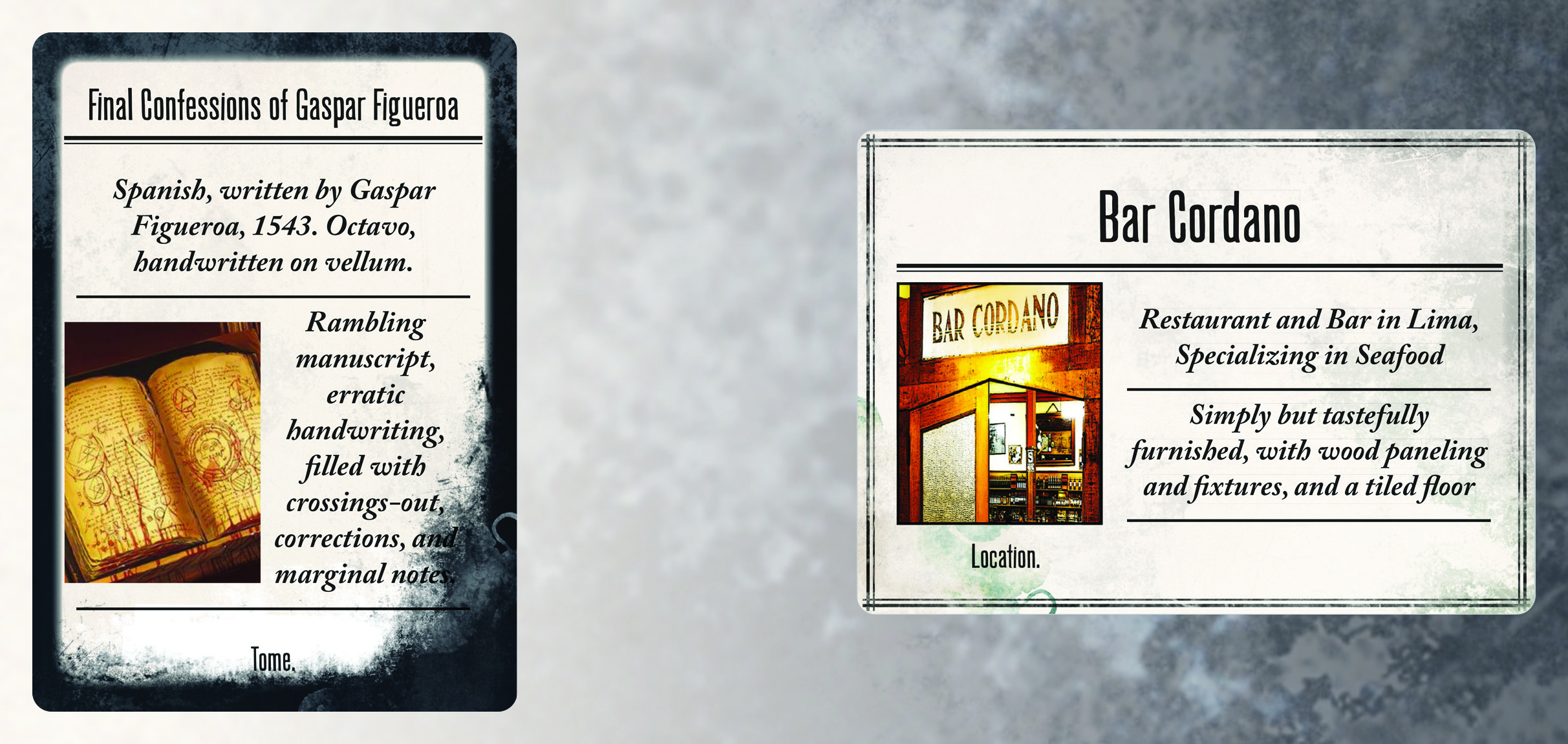
Examples of two cards from our Peru session.
Day 2
After securing their weapons and making delivery arrangements, the investigators met up with Elias and headed for the museum. Elias introduced them to Sánchez, who explained what he knew about the pyramid and that his grad assistant was working on the details. Washington was surprised that Sánchez didn’t know anything about the cult that Elias was investigating. The investigators got tired of waiting for Rizo and decided to head downstairs to talk to her, but not before debating about whether or not they wanted Elias to accompany them. The discussion almost escalated to an argument – in hushed whispers since they were still in Sánchez’s office – but they finally agreed to have Elias stay with Sánchez while they went to the storeroom.
The investigators headed downstairs into the dim basement corridor and easily located the storeroom. Already on edge in the low lighting, the discovery of Rizo’s nearly mummified body weakened the resolve of the group – especially Dibden – but all managed to keep it together. Dibden examined the body and was able to conclude a caustic substance dissolved some of the tissue and fat appeared to have been sucked through the gaping wound in the chest. He also noticed a notebook tucked in her pocket. Washington noticed the glint of the Golden Ward in the debris around the body – and then saw the bloody footprints leading to another door in back of the storeroom. Jennifer wanted to leave, and Washington and Dibden argued about whether or not they should follow the footprints. Hearing an echo of screams from somewhere upstairs brought the situation to a head. Dibden and Washington grabbed the notebook and the Golden Ward before heading back up the way they came. Jennifer had no interest in going towards the source of the screaming, but after an exclamation of, “I’m not staying down here alone!” she promptly followed them upstairs.
As they reached the ground floor, the group heard screams and commotion coming from outside – as well as sounds of scuffling from inside Sánchez’s office. The investigators quickly split up, with Dibden heading outside to see if he could provide medical assistance and Washington and Jennifer entering the office.
Dibden quickly located the source of the screaming as a crowd standing around Elias, who appeared to be crouched over someone else lying in the street. Rushing up to the scene, Dibden found Elias trying to stop the blood coming from a wound in an elderly woman’s stomach. Wasting no time to render what aid he could, Dibden asked Elias what happened while he started working to save the woman. “Not sure. I heard screams and came outside. Found her like this. They’re saying something about a man with a sword,” indicating the gathering crowd.
Washington and Jennifer entered Sánchez’s office to find someone standing with his back to them next to the desk, and they could just make out the professor’s struggling body on the other side. Washington rushed forward to restrain the attacker and was shocked with how easily he was flung backward. His shock was compounded when the attacker turned – Mendoza in full kharisiri form. Jennifer quickly drew her Derringer and fired, striking Mendoza in the chest. Mendoza just snarled (courtesy of Syrinscape), which immediately triggered a, “Oh hellll no!” Washington, lying on his back, also drew and fired a volley of shots from his pistol, which felled Mendoza.
Hearing the shots, Dibden and Elias instructed the onlookers to get help for the now-stabilized woman and began running back to the museum. Elias asked what was going on, to which Dibden replied, “We found Rizo dead downstairs and heard noises coming from the office.” Elias drew his pistol and sped up, with Dibden barely keeping pace.
Dibden and Elias enter the officer to find Washington checking on Sánchez and Jennifer keeping her distance from Mendoza’s body. “We should probably see if he’s alive or dead… but I’m not going to check to see if he’s dead!” With Sánchez writhing on the floor in obvious pain and moaning about being kissed, Dibden immediately checks him over. Upon discovering something moving in his abdomen, the team comes up with a plan of action. Jennifer pins her boot on Mendoza’s neck and cover him with her Derringer, while Washington covers both Sánchez and Mendoza with his pistol. Elias holds Sánchez down while Dibden performs an impromptu surgery to remove whatever is inside him. They manage to remove a large larva-like creature and promptly kill it – and of course everyone’s grossed out.
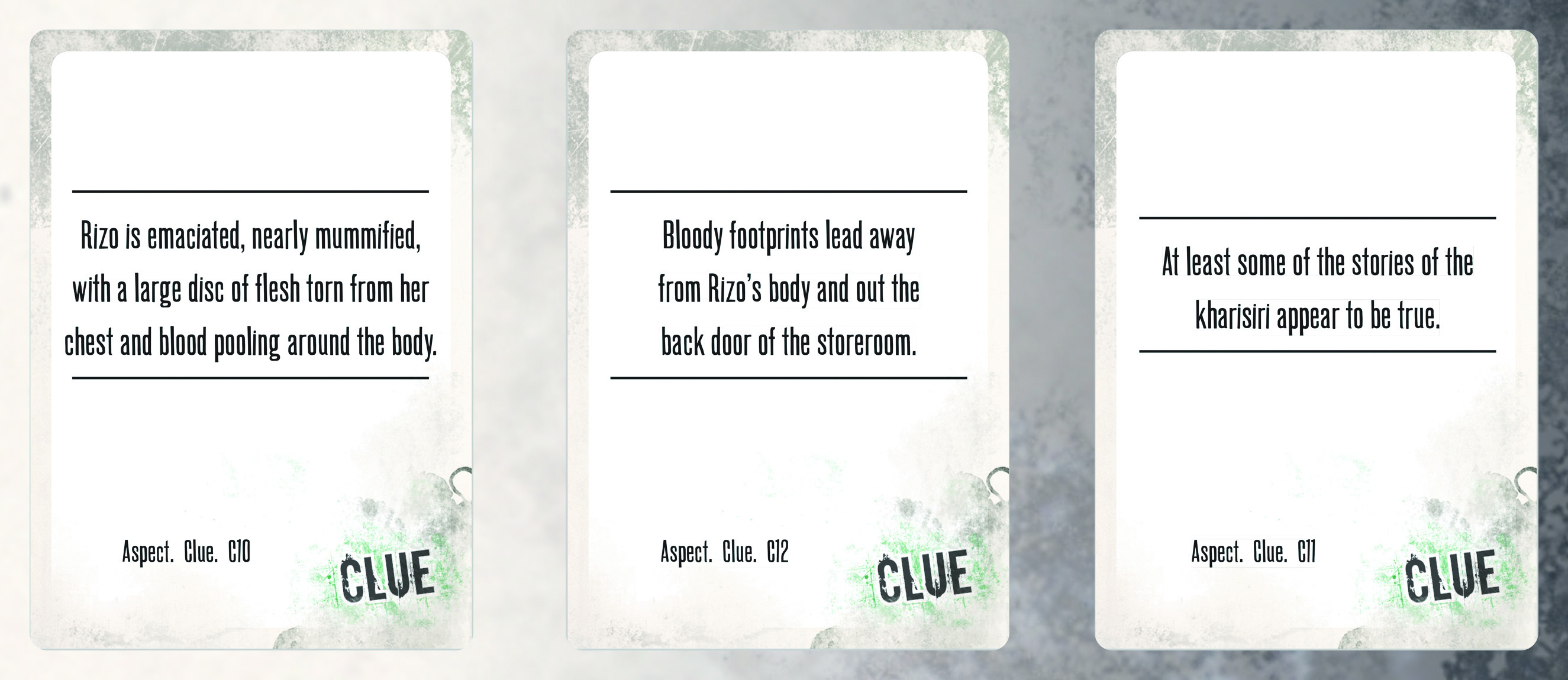
Example clues from our Peru session.
With Sánchez stabilized, Dibden turns his attention to Mendoza. He confirms Mendoza appears to be dead and inspects the odd structure of the mouth. Verifying this is the likely cause of Rizo’s injuries, the doc also determines that Mendoza was at least once human. The investigators start discussing what to do next, when Elias points out that Sánchez needs medical care and two dead bodies – one riddled with bullets – will require some explanation to the authorities. Elias goes outside to grab any medical personnel that may be assisting the woman on the street. He brings two men back, whispers to them for a couple of minutes and pays them, and then informs the investigators that these men will see Sánchez safely to the hospital. He suggests the investigators head back to the hotel – he will talk to the police when they arrive and ensure Rizo’s body is properly cared for while questions regarding Mendoza are kept to a minimum. He asks one of the investigators to leave their pistol behind so he can provide it as evidence. Everyone agrees and the group heads out.
Washington, Dibden, and Jennifer return to their hotel and review Rizo’s notes. The group quickly concludes that the gold from the pyramid must be cursed and that they should return it in order to bring the curse to an end. Elias arrives and tells everyone that he has handled the police, but that Mendoza’s body disappeared while they were downstairs with Rizo. The group is unnerved by the news, but not surprised. Elias also checked on Sánchez and verified he will recover. After some debate about whether or not they should trust Elias, Washington shows him the notes and the gold. Elias points out there is something on the Golden Ward, which Dibden identifies as skin – suspecting that the gold somehow harmed Mendoza. The group reviews their options to see what else they might learn before the expedition departs on Monday morning and decides to check out Larkin and Mendoza’s hotel.
Rather than accompany the others directly to the hotel, Jennifer and Washington first stop to sends some additional telegrams to Jennifer’s family contacts to see what they can confirm about Elias.
Elias and Dibden head to Hotel España and gain access to Mendoza and Larkin’s rooms after confirming that neither is there. They find Mendoza’s room largely unused, but discover and take the Golden Mirror. They find heroin in Larkin’s room, confirming Dibden’s suspicions about his condition. They rendezvous with the others in the lobby and are still there when Larkin returns to the hotel. They follow him to his room to find him high and only marginally coherent. Following a brief discussion with Larkin, Elias finally confronts him with the truth about Mendoza. Eventually Nyarlathotep briefly assumes control of Larkin to make a few vague threats, followed by Larkin collapsing long enough for Dibden to examine him – discovering the strange tattoo on his chest, the failing state of his physical body, and the fact that he does not appear to be a kharisiri or host to a larva.
Larkin’s Tattoo
Leaving Larkin in his room and returning to Hotel Maury, the group decides to spend Sunday trying to find out what they can about Larkin’s tattoo and anything else they can learn. They also decide that they will meet Monday morning to continue with the expedition as planned, but if they don’t like what they see they still want to go to the pyramid. Elias says that with what they know now, he believes he knows someone in Puno who could direct them to the pyramid’s location. The group asks Elias to make alternative travel arrangements to get to Puno, and Elias agrees on the condition that the investigators can cover the costs of the trip. Jennifer assures him that won’t be a problem.
Day 3
Sunday morning, Washington and Jennifer head to the telegraph office where they receive some telegrams from Jennifer’s contacts. Most cannot offer much on such short notice, but they are able to confirm Elias’ story and reputation. They also confirm Larkin comes from money but is something of a black sheep – and that he has travelled a great deal in the last couple of years.
Meanwhile, Dibden and Elias hit a couple of libraries trying to learn about the tattoo. Finally, Elias points out that without some point of reference, finding information in a library or museum related to a description of an unknown tattoo will be difficult. He offers to contact some of his associates knowledgeable in the occult, but doubts any information will be forthcoming before they have to leave for the pyramid. The team also learns that Larkin left his hotel first thing Sunday morning and that neither he nor Mendoza have returned since. Elias arranges travel for the group.
Day 4
Monday morning, everyone meets in front of Hotel España, where the trucks and drivers are waiting for Larkin, who is evidently a no-show. The investigators take delivery of their rifles and ammunition, grow tired of waiting, and head into the hotel to find Larkin’s room cleared out. With that, they decide to take advantage of Elias’ arrangements. The group takes a steamer up the coast and then catches the train north to Puno, all on Jennifer’s dime. She seems unaffected by the high altitude, with Dibden and Washington’s military and boxing backgrounds serving them well as they easily make the adjustment to the elevation.
Once in Puno, Elias asks around until he learns that his friend, Nayra, is hiding from suspected kharisiri on one of the islands on Lake Titicaca. The groups heads to the docks, where they notice a couple of people watching them, then take a small boat to the island. Nayra greets Elias and tells them about the legend of the pyramid – the Tiwanaku built it to contain a ravenous god that fell from the sky using “spells worked in gold”. Two kharisiri arrive on a boat and attack, but are quickly felled by the group with rifles. As it dies, one of the kharisiri threatens the team in Spanish that Elias translates as, “You too will serve the Father of Maggots.” Hearing this in contexts with other stories she has heard, Nayra concludes that this may be another name for the god dwelling inside the pyramid. She expresses concern that the recent stories of the kharisiri have including attackers of native descent as well as white men. She thanks the group for their help and assists with getting them supplies before seeing them off with directions to the pyramid.
The investigators are anxious to reach the pyramid before Mendoza or Larkin and remain convinced that they must return the gold – including the Golden Ward, the Golden Mirror, and the pendant and cup last seen in the possession of Larkin – in order to break the curse of the kharisiri. Washington keeps watch the first night in camp on the way into the highlands. Hearing strange noises, he rouses everyone else and the group finds one of their pack animals dead, its wounds matching those found on Rizo’s body.
Day 5 & 6
The following day, the investigators continue their trek into the highlands. When they hear gunshots ring out, they dive for cover behind the rise of a hill. They have stumbled upon two farmers – a man and his son – who were recently attacked by kharisiri. After convincing the father they are not kharisiri themselves and mean him no harm (depending on Elias to translate), Dibden treats the son’s wounds before the group sets off after the attackers. They finally catch up with two kharisiri the following day and follow them to the ruins and the pyramid.
The group surveys the ruins from a nearby overlook and watches as the two kharisiri each ascend the pyramid and vomit into a large crack on its flat peak. When the kharisiri disappear on the far side of the pyramid, the team descends and locates a section of wall buried enough to allow them easy access to the ruins. The entire site smells retched and is buzzing with flies. The group first ascends the pyramid, where they discover vile remnants of fat around a crack in the roof, and an odd bubbling sound from deep within. The team decides they want to try and fill the crack in, so they begin searching the ruins for loose stone or anything else they can use. As they explore, Washington falls into an exposed chimney. He is a little banged up but otherwise okay, and discovers and angled shaft that leads deeper underground. Consulting Rizo’s notes, the group reluctantly decides they need to go into the tunnels and this shaft will probably get them there. After briefly considering lowering a lama into the hole to use as some sort of bait/sacrifice/canary, the investigators and Elias all climb down into the tunnels.
Finding themselves in dark, squat tunnels, the investigators quickly reappropriate part of Jennifer’s wardrobe – specifically her scarves – to cover their faces so they can tolerate the nauseating stench that only strengthens as they continue on. The shaft dropped them into the tunnels at a T, so the investigators have three possible directions to travel. After orienting themselves with the ruins above, the group decides to head south. Slowly following a band of worked gold set into the walls on one side of the tunnels, the twisting tunnels eventually lead to a large pool of rancid fat that extends across the entire tunnel. A ragged but narrow crack lies in the wall, evidently the source of the fat, and the group watches in disgust as a larva like the one they removed from Sánchez wriggles through the crack and drops into the pool.
With the band of gold broken around the crack, the investigators quickly conclude they need to fit the Golden Ward into the gap, but the bubbling and constantly shifting pool is so large that there is no way to easily reach the break. After some discussion, Washington manages to use his engineering know-how and some of their supplies to rig a small floating raft. Dibden volunteers to precariously use the raft to secure the Golden Ward in place. As he does so, a low rumble shakes the ruins, and the fat in the pool begins to dissolve. The group hears sounds coming from the tunnel back from the direction they came.
The investigators continue to follow the golden band around the base of the pyramid, looking for any other gaps where they might place the Golden Mirror. They come across a decayed skeletal corpse and the remains of another larva, but find no other breaks in the gold around the pyramid. Finding themselves back at the chimney where they entered the tunnels, the group continues to explore the remaining passageway, which they discover also branches in two directions.
Again heading south, the investigators eventually discover an opening surrounded by very old human remains. Passing through, they find themselves in a large open pit in the ruins amidst piles of corpses in varying states of decay. Quickly deciding they would rather be elsewhere, the group returns to exploring the tunnels. Following the only remaining path, the group reaches a final chamber containing the remains of the two kharisiri they saw earlier, along with thousands of dollars’ worth of valuables and artifacts dating back centuries. Hearing noises from the chimney, the group fears they may have company. They decide to climb up and face whoever (or whatever) has arrived for them, only to discover several kharisiri stumbling towards the pyramid. One by one, the kharisiri collapse and die. The investigators are unsure what to do with the Golden Mirror, but are hopeful that they have succeeded in ending the kharisiri threat.
Finally, the group discusses what to do with the valuables discovered in the tunnels. Washington refuses to remove anything, asserting that it does not belong to him – and possibly fearing another curse. After Elias states his intentions to bring Sanchez in to inspect the artifacts and work with Nayra to try and locate the owners of any of the more recent valuables, he points out that they would be fools to not take a little something for themselves after all they’ve been through. Dibden and Jennifer agree and decide to take a small sum for themselves.
With that matter settled, the group discusses the need to seal up the tunnels to protect anyone else who might stumble across site. Elias agrees that after Sanchez has had the chance to remove any artifacts from the chamber in the tunnels, they will enlist a few trusted souls to seal up whatever the can. Satisfied and eager to be rid of the place, the four set off to return to Puno.

 A character that has faced exposure to the Mythos is fundamentally changed by the experience. Their perception of reality is altered – they literally perceive the world around them differently from those that have not seen what they have seen. They see and hear things which other humans do not; their senses of taste, touch, and smell are no longer the same. They may even begin to experience sensations that do not fit our normal human concepts of the senses. This may start small, bordering on imperceptible, but as a character is repeatedly exposed to greater evidence of the awful truth of the Mythos, this change becomes even more profound. (On the GM/Keeper side of the table, this can be used to provide a player with Clues due to their character being able to perceive things other cannot. Of course, Compels based on seeing or hearing things are also fertile grounds for the Keeper to play around in.)


 Differences Between The Haunting and Peru
 The first thing I did was to give clues a little more of a defined structure. Rather than a document or “the information Mr. Knott told you” being treated as a clue, each piece of relevant information obtained from those sources is a separate, discrete clue. So a document may contain several clues, each of which is written as a short, bite-sized, phrase or sentence. (Each Clue is also an Aspect, which has some other interesting advantages, but more on that elsewhere.)


 Investigators can visit locations and engage in Encounters. Think of Encounters like common scenes in an RPG, for a Lovecraft game something like looking up some information in the local library or purchasing supplies. You may talk to some NPCs and make a few skill rolls, and the scene could even be really important. But if there isn’t any detailed combat or exploration, and the relative positions of the investigators don’t matter, then it can be handled as an Encounter.